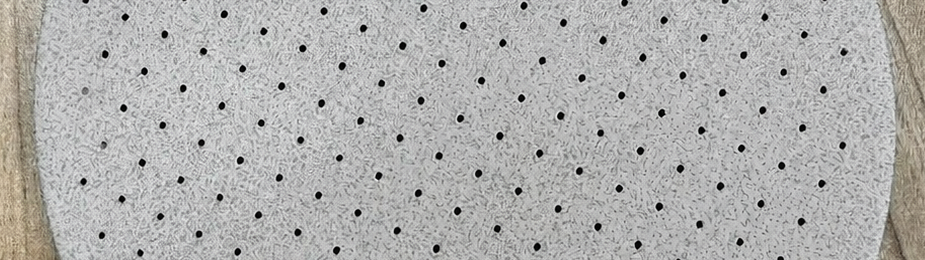
Foam laser cutting with less waste and more design freedom
Reduce material waste. Cut detailed geometries. Change designs without new tooling.
Zenna Laser develops foam laser cutting systems that reduce material waste, cut small holes and complex contours, and switch designs without tooling. Request a cutting test.
Control of heat and edge colour
Foam responds to heat differently depending on its composition, density, thickness and additives. Too much energy or insufficient extraction can affect the cut edge or cause discoloration.
Zenna controls the process through laser power, cutting speed, focus and extraction. If required, the contour can be cut in several passes at lower power. This limits the thermal load while maintaining the required geometry.
Send us your material, drawing and quality requirements. We test the complete product and show you the cut result before a machine concept is developed.
Which foams can be laser cut?
Suitability cannot be determined from the material name alone. Additives, coatings, adhesive layers and flame retardants can change the cutting result and emissions. Testing the actual material is therefore essential.
· Polyurethane (PU) foam
· Polyethylene (PE) and polyolefin foam
· Polyester foam
· EVA and other technical foams
· Laminated or multilayer materials when every layer is laser-compatible
Typical applications
A system built around your product
Zenna develops the complete production solution around your foam, product geometry, output and factory environment. Depending on the application, the system can include:
· CO₂ laser source, optics and validated process recipes
· Sheet, stack or roll handling
· Vision for alignment and inspection
· Automated loading, cutting, sorting and stacking
· Extraction, filtration, fire detection and machine safety
· Software connections to the production environment
From sample to production
Frequently asked questions
Can every foam be laser cut?
No. Composition, additives and coatings determine suitability. Zenna checks the datasheet and tests the actual material.
Can a laser cut small holes and the outside contour?
Yes. Both can be included in one digital cutting program. The achievable size and speed depend on the foam and thickness.
Does the laser discolor the foam?
Heat can affect some foams. Zenna limits this through the correct balance of power, speed, focus and extraction, and can use multiple lower-power passes.
How much material can be saved?
The exact saving depends on part geometry and nesting. Where die cutting requires about 3 mm between parts, laser cutting can often reduce this to less than 1 mm.
How quickly can a design be changed?
A new cutting file replaces the existing geometry. No new die is required.
Can Zenna test our finished product?
Yes. We can test your foam and product geometry so you can evaluate the result before deciding on the production solution.