Laser cutting technology for production: no tool wear, no quality drift
Laser cutting solves one of the main limitations of conventional cutting methods: mechanical contact between tool and material. A focused laser beam follows a programmed path through technical textiles, films, foils, abrasives or airbag fabric without applying force to the workpiece.
For process engineers, this means no edge deformation, no delamination, no tool wear and consistent quality across every part.
For operations managers, it means fewer changeovers, easier automation and a process that holds its accuracy from the first cut to long production runs. Zenna Laser integrates this technology into complete industrial machines, built around your material, requirements, output rate and production line.
Precise, contactless cutting for complex materials
Most cutting processes apply mechanical force to the material. A blade presses down, a die stamps through the material or a punch creates perforations. Each of these methods depends on the condition of the tool. As tools wear, cut quality can change. Edge geometry shifts, tolerances drift and production eventually stops for tool replacement.
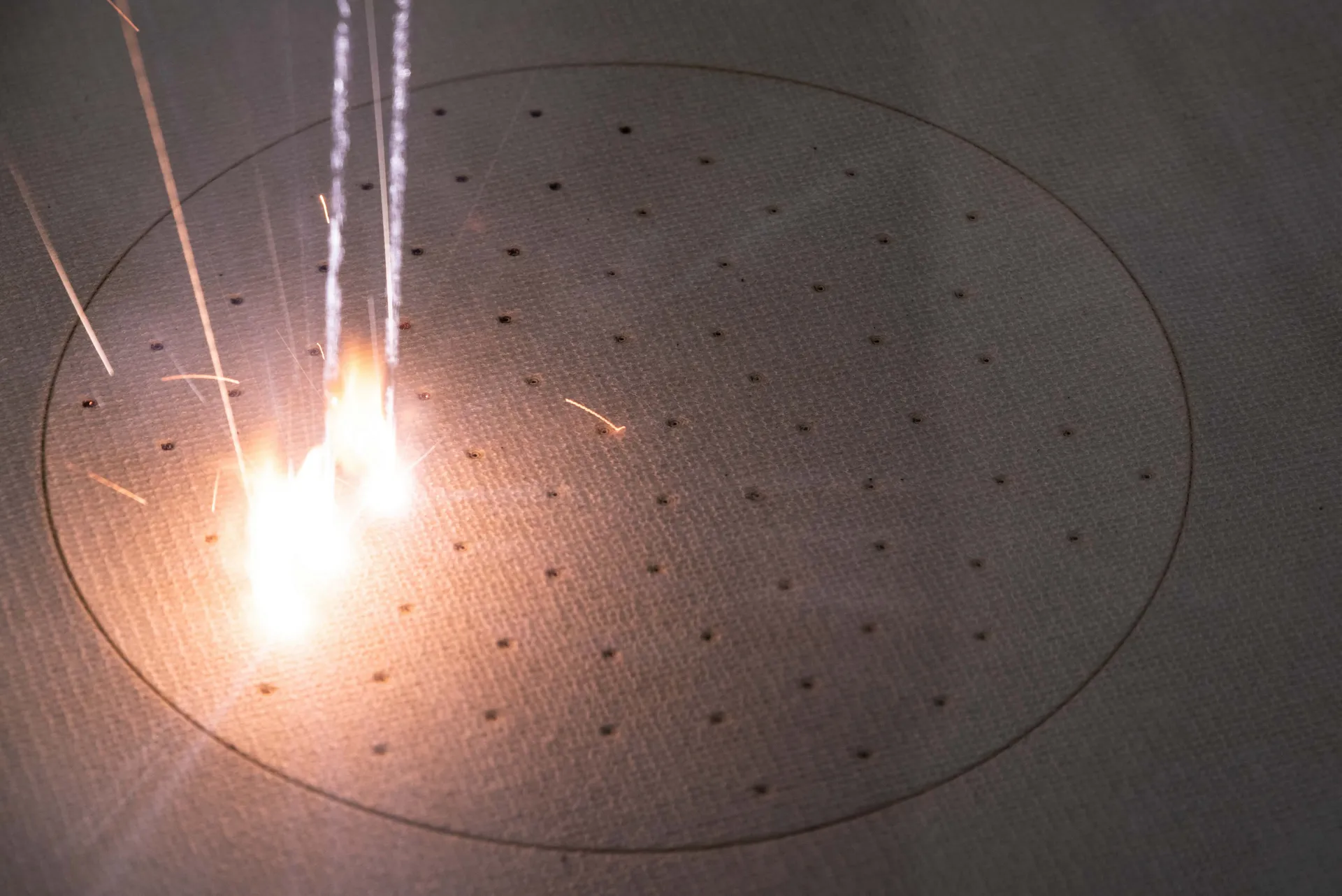
Laser cutting works differently. The laser beam transfers energy directly to the material at a defined point. The material absorbs that energy and separates in a controlled way. Nothing presses, drags or wears against the product.
For materials that are sensitive to deformation, such as airbag fabric, thin films, abrasive paper or technical nonwovens, this difference matters directly. The cut edge is determined by the beam position and process settings, not by the mechanical condition of a tool. Because there is no physical blade to dull, the process can maintain consistent quality over long production runs.
How laser cutting works
A laser source generates a concentrated beam of light at a defined wavelength. Optics focus that beam to a small spot and direct it onto the material surface. At that point, the energy density is high enough to heat, melt or vaporise the material in a controlled way.
The beam follows a cutting path defined in software. That path can be a straight line, a complex contour, a perforation pattern or any geometry the application requires.
The result is a clean separation at the programmed position. Because the “tool” is a beam of light, there is no burr from a worn die and no width variation from a stretched blade. The cut is a direct and repeatable output of the digital program.
Controlled energy, accurate cutting paths
The quality and character of the cut depend on several parameters working together. Laser power controls how much energy reaches the material. Cutting speed determines the energy dose along the cut path. Focal position defines the spot size at the material surface, which affects cut width and energy density. Material properties such as absorption, reflectivity and thermal behaviour determine which laser type is required.
Not every laser type suits every material. CO₂ lasers absorb well in many organic materials, such as textiles, paper, plastics and rubber. Fibre lasers are often used for metals and coated films. At Zenna Laser, machine configuration starts with the material, so the technology matches the physical requirements of your product.
Benefits of laser cutting in automated production
The operational advantages of laser cutting become most visible at scale: in high-volume production, in lines with many product variants and in processes where downtime has a direct cost.
Because there is no physical cutting tool, laser cutting removes tool condition as a variable in the process. The cut quality does not gradually degrade due to blade or die wear. A line that runs continuously can maintain the same edge quality over time, provided the process settings and material flow remain controlled.
Laser cutting also removes the maintenance cycle associated with die cutting and punching. There is no cutting tool to inspect, resharpen or replace. This reduces planned and unplanned stops related to tooling wear.
For complex geometries, the laser beam follows the digital path with high accuracy. Tight radii, asymmetric shapes and multi-contour parts can be processed without additional tooling cost per shape.
Because the cutting head does not touch the material, laser cutting is also easier to integrate into automated production lines. It can be used in roll-to-roll, roll-to-sheet or robot-fed systems without adding mechanical load to the material or surrounding process steps.
No dedicated tooling for every product variation
In mechanical cutting, each part shape often requires its own die or blade configuration. When a new product is introduced, a new tool is needed. When an existing product changes, the tool has to be modified or replaced. Over time, the tooling library grows, along with cost, lead time and changeover complexity.
With laser cutting, the cutting path is a software file. Changing from one product to another means loading a different file instead of changing physical tooling.
A single machine can run one product in the morning, another after a short changeover and a third the next day without hardware modifications. For production environments with many product variants, short runs or frequent design changes, this flexibility reduces tooling overhead and makes planning easier.
Materials and applications for laser cutting
Laser cutting is used across industrial materials where mechanical cutting is impractical or does not deliver the required quality. These materials often respond poorly to pressure, friction or deformation from mechanical tools.
Common applications include airbag fabrics, coated technical textiles, abrasives, sandpaper, packaging foils, functional films, battery separator materials, electrode foils, nonwoven textiles, membranes, rubber, elastomeric sheet material, multi-layer laminates and composite films.
Laser cutting can be used for full separation along open or closed contours, perforation patterns, partial-depth scoring and sheeting of continuous roll material to fixed or variable lengths.
The exact process configuration depends on the material and required output. Zenna Laser qualifies each application through systematic material testing before machine specification. This ensures the system is built around the actual process, rather than adapting a general-purpose machine afterwards.
Combining laser cutting with vision and robotics
A laser cutting system that follows a fixed path is already more flexible than mechanical tooling. A system that can read the material before cutting and adapt accordingly goes further.
Vision systems give the machine real-time information about the material. This information can be used to correct the cutting path, reject out-of-specification material or trigger different cutting programs based on what the camera detects. In this way, the machine becomes an active part of process control and quality assurance.
Robotics can extend the system further. When material needs to be positioned, oriented, loaded, unloaded or stacked, robots can take over tasks that would otherwise require manual operators.
From material detection to automated cutting
Vision data does more than confirm part position. In roll-to-roll processes, material can shift laterally or stretch during winding. A vision system that tracks registration marks or edge position can feed corrections directly to the motion controller. This ensures the cutting path follows the material as it actually runs, not as it was assumed to run.
In applications where the pattern on the material determines where the cut must go, such as printed packaging or patterned textiles, vision-guided cutting reduces positional error. The system finds the correct cut position from the print, seam or reference feature instead of relying only on fixed coordinates.
The result is a production system that can handle real-world material variation instead of requiring every variation to be eliminated upstream. This leads to fewer rejects, fewer manual adjustments and a process that is easier to manage across different shifts.
Laser cutting machines built around your process
Zenna Laser does not sell standard machines from a catalogue. Each system is specified for a particular material, output rate and production environment. If the application is new, we test it first in our lab to prove the process and validate the result.
If you are evaluating laser cutting as an alternative to your current process, or if you have a specific production problem to solve, the best starting point is a technical conversation or a material test.
We work directly with engineers and production teams to make sure the technology delivers the required performance on the factory floor.