Vision systems for positioning and quality control
A standard laser system follows a fixed program and relies on the material to be in the expected position every time. In a real production environment, materials can shift, stretch or vary. Vision systems give the machine the ability to observe and verify the workpiece in real time, so the laser acts on the actual position of the material instead of a theoretical coordinate.
At Zenna Laser, vision technology is treated as a core functional part of the system, not as an optional add-on. By integrating cameras and sensors directly into the cutting, marking and handling process, the machine can automatically adjust to variation. This helps keep every cut, mark or handling step accurate, even when material tolerances or positioning are not perfectly consistent.
Vision systems can also measure cut parts and determine whether they remain within predefined tolerances. When a process starts to move towards the tolerance limit, the system can show warnings on the HMI or even send correction feedback to the laser process.
The integration of vision systems in Zenna Laser machines is made possible by our powerful ZocuPro 5 software platform.
Make your production process see before it acts
Most production errors are not caused by a machine executing incorrectly. They are caused by a machine executing correctly on the wrong input: a part that shifted, a material edge that drifted or a defect that was already present before processing started.
A machine without vision has no way to detect this. It completes the operation and passes the problem downstream.
Vision changes that sequence. The camera observes the actual state of the material or product. The software interprets what it sees and compares it with what is expected. If something is outside tolerance, the system can correct its position, adjust the process or stop before a defect becomes a scrapped part.
The machine acts on reality, not on assumption.
Product recognition and positioning
Before a laser can cut or mark accurately, it needs to know where the product is and, in many cases, what the product is.
A roll of material that has shifted laterally by two millimetres, a part that arrives slightly rotated or a panel with a printed pattern that needs to be cut in registration cannot be handled reliably by a fixed coordinate system alone.
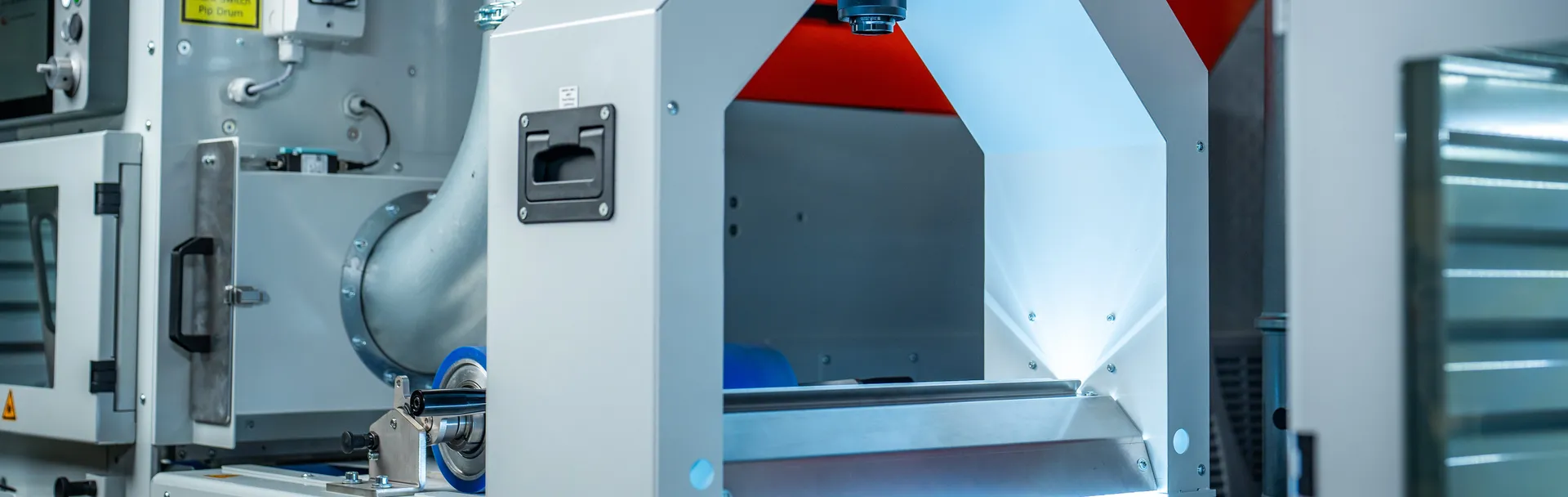
Camera systems mounted at the processing station capture an image of the material or product as it arrives. The vision software identifies reference points, such as an edge, printed mark, seam, hole or corner. It then calculates the actual position and orientation relative to the expected position.
That positional data is passed to the motion controller, robot or laser system before the process begins.
Accurate alignment for laser and robotic processes
For laser cutting, positional correction means the programmed cut path can be shifted or rotated to match the actual material position. If a printed pattern on a film must be cut in exact registration, the vision system finds the print, measures the offset and allows the laser to follow the corrected path.
The operator does not need to intervene. The correction happens automatically, every cycle.
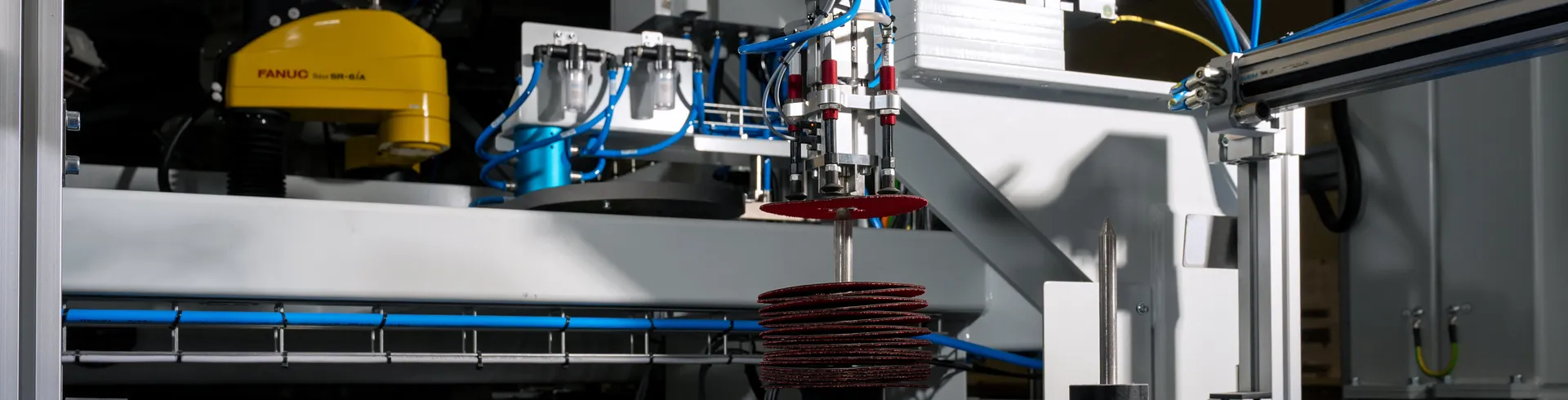
For robotic handling, the same principle applies. A robot programmed to pick a part at a fixed coordinate will fail if the part is not at that coordinate. With vision, the robot receives the actual position before each pick and adjusts its movement accordingly.
This makes robotic handling suitable for applications where part presentation is not perfectly consistent.
Automated quality control during production
Inspection at the end of a production run finds problems after they have already cost time and material. Inspection inside the production process finds them as they occur, at the point where correction or rejection is still possible.
Vision systems for in-process quality control can inspect edge quality after cutting, verify that a marking is complete and positioned correctly, check whether part dimensions are within tolerance, detect surface defects on incoming material or confirm that a robotic operation was completed as expected.
The inspection runs at line speed, on every part, without adding manual inspection work.
Detect defects before they become production waste
The earlier a defect is detected, the lower its cost.
A defect found on incoming material before it enters the cutting station saves cutting time. A defect found immediately after cutting saves downstream handling, finishing and packaging time. A defect found only at final inspection has already consumed the full production cost of that part.
Vision-based inspection at the right point in the process changes the economics of quality. Reject rates can be reduced because problems are detected before they compound. Manual inspection steps can be reduced or removed. Because the system logs what it detects, the data can also be used for process analysis, helping teams identify patterns and address root causes.
Vision-guided robotics
A robot operating in a fixed and fully structured environment does not always need vision. Most industrial production environments, however, are not fully structured. Parts vary slightly, positions drift and batches change.
When these variables exceed the tolerance of a fixed robot program, the process becomes unreliable.
Vision-guided robotics connects the camera system directly to the robot controller. The vision system locates the part, determines its position and orientation, and sends that information to the robot before each operation. The robot then adjusts its path accordingly.
Pick-and-place applications, part feeding, stacking and transfer operations all become more reliable when the robot knows where the part actually is, instead of where it is assumed to be.
This approach also makes robotic systems more flexible. When a new product or part type is introduced, the vision system can be updated with the new reference. The robot program can then adapt without physical retooling. One robot cell can handle multiple product types, selected automatically based on what the camera detects.
Vision applications require engineering, not just hardware
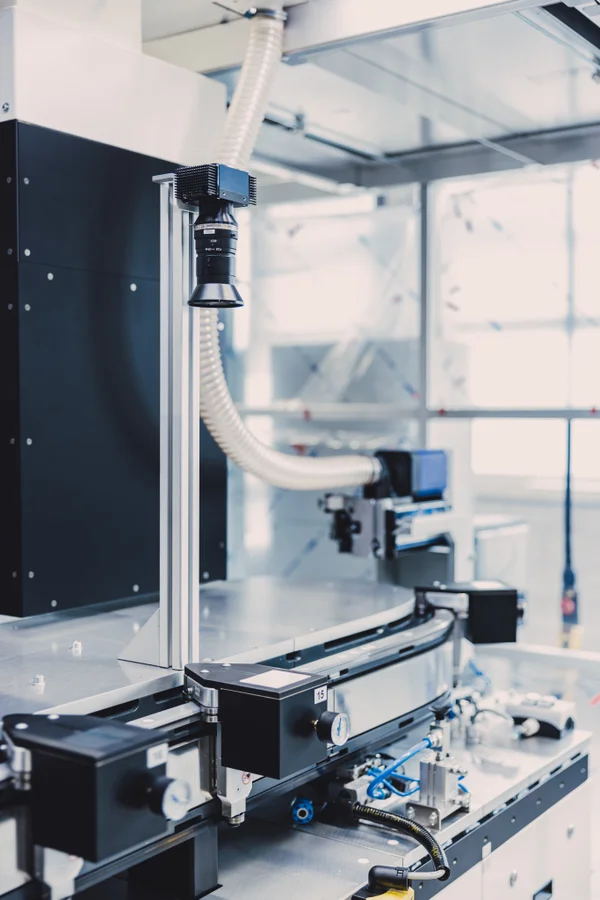
A camera and a light source are only the starting point. Every vision application requires engineering choices that determine whether the system works reliably in real production conditions.
The lighting setup, including angle, wavelength and intensity, determines whether the camera can distinguish the required feature from the background. A system that works under controlled conditions may fail when ambient light changes or when the material surface varies across a batch.
The software algorithms that interpret the image must also be developed and validated for the specific task. Edge detection, pattern matching, defect classification and dimensional measurement each require a different approach. A generic algorithm applied to a specific industrial material will usually need careful configuration before it performs reliably in production.
Zenna Laser engineers vision systems from the application outward. We start with what the machine needs to know, then design the optics, lighting and software to answer that question reliably under the actual conditions of the production line.