Laser marking technology for industrial materials
Laser marking is a modern engraving and marking technology for product identification, branding, traceability and anti-counterfeiting. It applies a permanent mark to a material surface without physical contact: no ink, no labels and no printing heads pressing against the product.
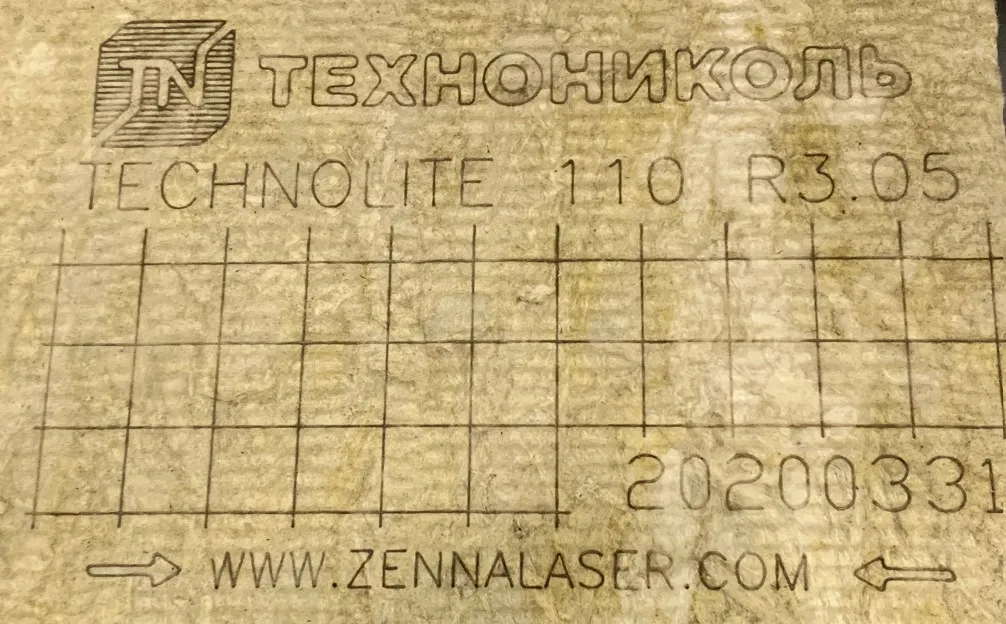
A programmed laser beam can mark text, logos, product names, batch codes, grids, arrows, recycling information, insulation values, thickness indications, sizes or graphics directly onto the material. The mark becomes part of the surface itself, which means it does not fade, peel or wear off.
For production environments where marking quality, traceability or brand consistency matters, laser marking removes many of the variables that traditional marking methods introduce.
Permanent marking without contact-based processes
Traditional marking methods, such as hot wheels, inkjet and press printing, often involve physical contact with the material or consumables such as ink, ribbon or labels. Each of these introduces a point of maintenance, a source of variation or a limitation in what can be marked and where.
Laser marking works without contact and without consumables. The beam reaches the material surface, transfers energy at a defined point and changes the surface locally, leaving a visible and permanent mark. Nothing touches the product, and nothing needs to be refilled, replaced or recalibrated because a nozzle has dried or a wheel has worn.
In dusty or demanding production environments, such as mineral wool lines, abrasives manufacturing or continuous wide-web processes, this is especially valuable. There are no ink lines to block, no contact elements to wear against the material and no printing heads that need constant attention. The system marks reliably in conditions where traditional technologies often require more maintenance.
How laser marking works
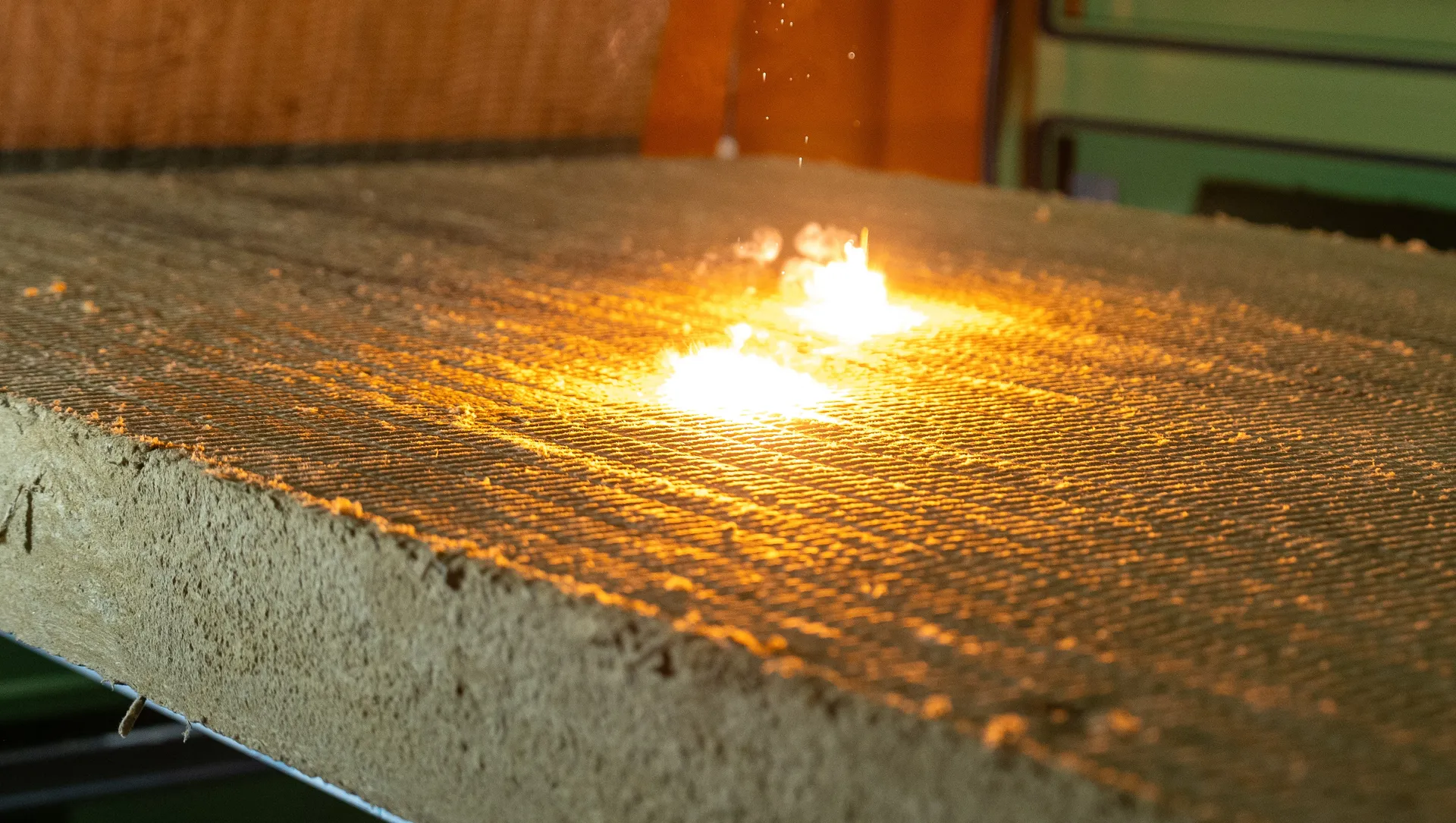
A laser source produces a focused beam of light at a defined wavelength. The beam is directed by a scanner: a set of fast-moving mirrors that steers it across the material surface according to a programmed pattern.
Where the beam hits, it deposits energy. The material responds by changing colour, removing a surface layer or engraving slightly into the substrate. The result is a visible and stable mark.
The scanner moves fast enough to mark text, logos, codes or complex graphics in fractions of a second. On a moving production line, the system can track material speed with an encoder and adjust the marking position accordingly. This ensures that the mark lands where it is programmed to land, even at production speed.
Controlled marking parameters for consistent results
The appearance and depth of the mark depend on how the process is configured. Power determines how much energy reaches the surface. Speed determines how long the beam interacts with each point. Together, these settings control contrast and readability.
Resolution defines how fine the detail can be. Small text, tight grid lines, QR codes or high-resolution logos all require the right beam size, scanner settings and material response.
For materials with surface variation, such as mineral wool or stone wool, the parameters are tuned so the mark remains readable across the full width of the product, even when the surface is not perfectly uniform.
Once a marking program is tested and approved, it runs the same way every cycle. There is no operator adjustment required to maintain quality, and no gradual drift as consumables run out.
Applications for laser marking
Laser marking is used wherever a production process requires a mark that is permanent, repeatable and applied without stopping or slowing the line.
In the insulation materials industry, including mineral wool, stone wool and glass wool, laser marking is an established alternative to hot-wheel and inkjet methods. Producers use it to apply brand logos, product names, installation grids, arrows, product references, batch codes, insulation values, thickness indications, size information and required legislative information such as recycling symbols.
These markings support product identification, installation guidance, traceability, branding and compliance throughout the supply chain. Because the information is applied directly to the material, it remains visible during handling, packaging, transport and installation.
Beyond insulation materials, laser marking is used for product identification and traceability on technical films and foils, batch and date coding on industrial materials, anti-counterfeiting marks that are difficult to replicate, and alignment marks on large-format products.
As European legislation moves further toward material passports and improved product traceability, laser marking offers a practical way to apply required information permanently to the product itself.
Zenna Laser offers the MultiMarker series and MultiMarker Compact series for industrial marking applications.
Large-area and inline laser marking
Standard laser markers are suitable for small marking fields, such as a label area, a single code or a defined zone. For wide materials or applications where marking must cover a larger part of the product surface, a different approach is needed.
Zenna Laser has developed marking systems for wide-web applications since 2006. The FullWidth Marker covers material widths up to 2.6 metres and can place markings anywhere across the full width in a single pass. The BannerMarker applies intense markings on defined lanes, making it suitable for branding strips, bold text or continuous visual communication along the length of the product. The Bottom BannerMarker marks the underside of the material as it passes through the line, without requiring the material to be flipped or rerouted.
These systems can be mounted above or below an existing conveyor and integrated into the production line without major changes to the layout. The material does not need to stop, and the line does not need to slow down.
Variable content and production data
Not every product in a production run carries the same marking. Batch numbers change per run, date and time stamps change continuously, product codes vary between orders and customer-specific branding may differ per product type.
A marking system that requires manual intervention for each change introduces both delay and risk of error.
Zenna Laser marking systems manage variable content through the machine HMI or through a connection to the line control system. A new marking program can load quickly, without a physical changeover. The system can switch between a logo, product code, grid pattern, batch number or traceability code within the same production run, triggered automatically by the line controller or production management system.
For producers working toward traceability requirements or material passport compliance, this means required information can be applied consistently and automatically without adding an extra operator task to the line.
Benefits of laser marking in production environments
Laser marking reduces the number of variables in the marking process. There are no inks, ribbons or labels to manage, no nozzle cleaning schedules and no contact elements pressing against the material.
Maintenance requirements are low. The laser source has a long operational life, and the scanner mirrors do not require regular replacement. In practice, this creates a marking system that can run reliably across shifts without needing constant attention from the maintenance team.
The quality of the mark remains consistent over time. The first mark of a production run and the last are produced by the same beam, at the same settings, with the same result. For producers who supply to brand owners or need to meet marking standards, this consistency is a core advantage of the process.
Laser marking also supports cleaner production. Because the process works without inks, labels or printing consumables, it reduces waste streams and makes marking easier to integrate into automated production environments.